Kindergarten – Consecration & Sukkot
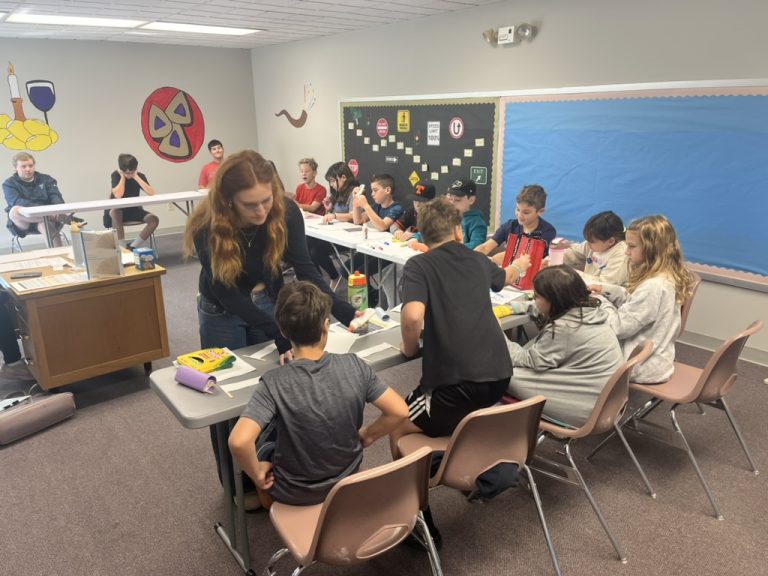
Today we celebrated Consecration and explored Sukkot — your child made a paper mezuzah model and helped build a sukkah from classroom materials. We learned the letter Vav (ו) and found twelve hidden Vavs in a room-wide search. A Vav coloring page from The Aleph Bet Story is coming home tonight.
Ask Your Student: Can you show me where a mezuzah goes on a doorpost — and can you draw the letter Vav for me?
First Grade – Abraham’s Search for God
We met Abraham as our first Jewish ancestor through the midrash of his search for God, then walked his journey from Ur to Haran to Canaan. Each child decorated stars and added them to our Abraham’s Stars display. Students also made Torah scrolls with the ShinShin.
Ask Your Student: What was Abraham searching for, and what did the stars help him imagine?
Second Grade – Garden of Eden & Responsible Choices
We retold the Garden story, explored the difference between yetzer ha-tov and yetzer ha-ra, and practiced apology versus repair. Each student chose a mitzvah to practice this week and added it to our class Mitzvah Tree.
Ask Your Student: What action did you write on your mitzvah leaf — and how is repairing a mistake different from just saying sorry?
Third Grade – God’s Gift & Holiness
Students used the Sinai story to explore holiness — kedushah — as something set apart for a sacred purpose. They sorted objects, actions and time into a Holy Things framework and chose a character value (compassion, peace or justice) to practice this week.
Ask Your Student: Which value did you choose, and what will you do to practice it?
Fourth Grade – Torah’s Ending & Jonah’s Beginning
Students connected Simchat Torah to the Torah’s last and first words, located Jonah in a print TaNaKh, and wrote commentary on Jonah 1:1–3 using textual evidence. They also matched Jonah’s port of Yafo to photographs of present-day Tel Aviv–Yafo.
Ask Your Student: What does Jonah actually do when God calls him, and what are we still wondering about why?
Fifth Grade – Moses’ Song & Beginning Torah Again
We explored the poetry of Moses’ final song, read Eitz Chayim Hi as a liturgical text rooted in Proverbs, and wrote a shared prayer-poem connecting Torah’s ending to its beginning. Simchat Torah was our frame throughout.
Ask Your Student: Why might we discover something new in a story we’ve already read before?
Sixth Grade – Lev: Last Page & First Page
Students compared the Torah’s final and opening words through chevruta text study, examined how the Israel and Diaspora calendars share the same yearly Torah cycle, and explored the 1844 Kol Nidre debate as a window into how liturgy carries memory. Each student sealed a private reflection on return to be opened in spring.
Ask Your Student: What is one practice our family might begin again?
Seventh, Eighth, & Ninth Grades (Tell Institute Pilot)
Today we explored some of the groundbreaking and countercultural ideas that the Jewish people introduced to the world, especially ideas that challenged the power structures of the ancient world. We discussed the belief that no human ruler is a god or above the law, that education should be available to everyone, that debate and disagreement are valuable, and that every person deserves rest. We also considered how these Jewish ideas challenged the assumption that power, conquest, and empire were the measures of a successful society, and why such ideas could feel threatening to those in power.
Ask your student: Which of the ideas you talked about today do you think is still the most important or radical today, and why?
Confirmation
As we near the third anniversary of October 7th, we began our session with a commemoration and opportunity to remember the events of that day with Ophir, our ShinShin. Then, after an opportunity for reflection, we turned to the main topic for our Confirmation Retreat – Jewish life in America and Civic Engagement/Participation. As part of our retreat to DC, we will meet with Representative Wagner’s office to advocate on issues that matter to us, so we first learned about important moments of Jewish advocacy in American history, both for the Jewish community and in partnership with our neighbors. Then, we introduced the “EPIC” format for advocacy writing, with the students beginning to think about what topic/issue they each want to focus on. We’ll have some time to work on this on Sundays in the coming weeks, and some work will need to be completed at home (more information sent to parent email).
Beren Scholars
Beren Scholars will have their first session on October 11th at B’nai Amoona! Stay tuned!
Stay connected!
Contact Samantha Fomera, Director of Youth Education & Family Engagement, at samantha@unitedhebrew.org to be added to the circulation of our e-blast newsletter!